ART ADORO STORYWORLDS
Barcelona
Gaudís letzter Plan
Die Zeugin aus der Bucht
Eine Bucht. Ein Film. Das Meer weiß alles.
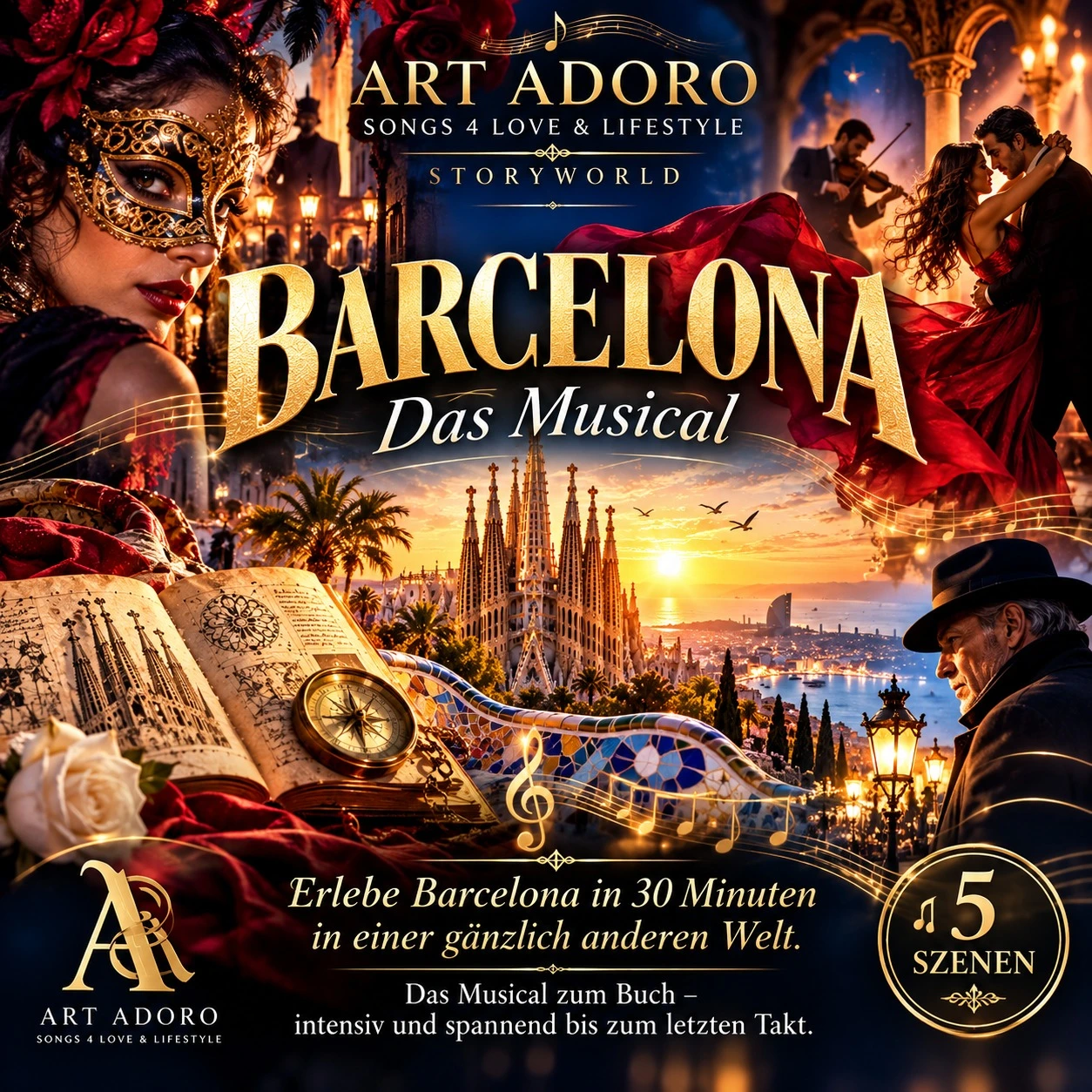
Eine Liebesnacht an der Costa Brava. Lichter auf dem Wasser, die dort nicht sein dürften. Lena filmt, was sie nicht sehen sollte – dann verschwindet sie. Zwischen Habanera, Flamenco Noir und Kathedralorgel führt das Musical zu Gaudís verbrannten Plänen und hoch auf die Sagrada Família.
Ein Musical in fünf Szenen
- 01
La Cala
Bucht an der Costa Brava · bei Begur · ca. 6:00
Eine kleine Bucht an der Costa Brava, ein Abend im September. Lena, Studentin der Architektur und Geschichte aus Velden, und Jordi, ein Bootsführer aus Begur, liegen im warmen Sand. Von irgendwo weht eine Habanera herüber, das alte Seemannslied der Küste. Es ist die schönste Nacht ihres Sommers. Dann gehen draußen auf dem Wasser Lichter an, die nicht dorthin gehören. Das Lied beginnt als Liebeslied und endet mit einem Atemzug, der stockt.
Romantische Habanera-Ballade der Costa Brava im sanft wiegenden Zweivierteltakt, 70 BPM. Nylonsaitengitarre, Akkordeon, Kontrabass, sanftes Saxofon und Wellen; warmes Duett und kleiner Männerchor auf Englisch, Spanisch und Katalanisch. Zärtlich und nostalgisch, am Ende gespannte Stille.
Stimmen: Duett: Lena (warme, klare Frauenstimme) und Jordi (weicher Bariton mit spanischem Akzent); kleiner Männerchor wie eine Habanera-Runde am Strand
Original-Liedtext
[Intro – waves on pebbles, nylon guitar, a distant accordion] [Verse 1 – Jordi] The sun went down behind Begur, the water turned to wine, you laughed and said you've never seen a sea so close to mine. Mírame, amor, no tengas miedo, the night is ours to keep. [Verse 2 – Lena] I came to read the old stone walls, to learn what Gaudí meant, but here between the rocks and you I don't know where it went. Bona nit, amor meu, hold me while the stars are deep. [Chorus – Duet, choir joins softly] La cala, la cala, the sea is full of light, a hundred years of sailors sang this song into the night. La cala, la cala, the water holds its breath, la mar ho sap tot – the sea knows life and death. [Verse 3 – Choir, like an old habanera] Our fathers came from Cuba's shore with rum and broken hearts, they sang of girls they left behind and maps without the charts. [Verse 4 – Lena, quiet, surprised] Jordi, look – out on the bay, a ship without a light, the lamps go on, the lamps go off, small boats rush through the night… [Pre-Chorus – Jordi, whispering] Don't look, mi vida, close your eyes, some things are better left unseen… [Chorus – Duet, uneasy] La cala, la cala, the sea is full of light, but not the kind that sailors sang about into the night. La cala, la cala, the water holds its breath, la mar ho sap tot – the sea knows life and death. [Bridge – Lena, half spoken] I raise my phone, I don't know why, the screen is glowing in my hand, a yacht, a crate, a frightened cry, and footsteps coming through the sand… [Instrumental – the habanera stops, only waves, one guitar string] [Outro – Choir, very soft] Lo que el mar se lleva, el mar lo devuelve… [Silence] [End] - 02
In the Cloud
Dunkle Bucht · Velden am Wörthersee · ca. 6:00
Lena wird gepackt, das Telefon fällt in den Sand. Aber der Film ist schon fort, hochgeladen in die Wolke, in ein Familienalbum. Zweitausend Kilometer entfernt, in Velden am Wörthersee, sitzt ihre Mutter abends mit dem Tablet auf dem Sofa und sieht ein neues Video ihrer Tochter. Lichter auf dem Wasser. Ein Schrei. Dann nichts. Das Lied pulsiert wie ein Herzschlag zwischen zwei Welten: der dunklen Bucht und dem stillen See.
Moderner filmischer Thriller-Pop, 110 BPM: elektronischer Herzschlag-Bass, Staccato-Streicher und Flamenco-Gitarrenriffs. Atemloser Sopran, warmer tiefer Alt, bedrohlicher Männerchor, digitale Störklänge und ein Saxofon-Schrei; Englisch mit spanischen und deutschen Zeilen.
Stimmen: Lena (gehetzt, atemlos), die Mutter (tiefe, warme Frauenstimme, voller Angst), Männerchor als „die Männer“
Original-Liedtext
[Intro – heartbeat bass, a phone notification sound, then running steps] [Verse 1 – Lena, breathless] Hands on my shoulders, sand in my eyes, the phone in the water, the sea full of lies, they're asking for something, they're tearing my bag, ¿Dónde está el vídeo? ¿Dónde está? [Pre-Chorus – Lena] But it's already gone, it's already flown, up through the night on a signal alone… [Chorus – Full] In the cloud, in the cloud, what you saw is never lost, in the cloud, in the cloud, somebody's watching, whatever the cost. They can take your voice, they can take your name, but the truth is up there, burning like a flame. [Verse 2 – Mother, in Velden, slow] The lake is quiet, the evening grey, a message from Spain, she's been gone all day, I press on play, and I see the bay, the lights on the water… and then she screams. Lena, mein Kind, wo bist du? [Verse 3 – Male chorus, low and threatening] Find the girl and find the phone, find the film she's not alone, every cloud has got a key, nadie escapa de la mar. [Chorus – Full] In the cloud, in the cloud, what you saw is never lost, in the cloud, in the cloud, somebody's watching, whatever the cost. [Bridge – Lena and Mother, from two different worlds] (Lena) Mama, can you see me? I'm under the stars. (Mother) I see you, my darling, the screen in my hands. (Both) Two thousand kilometres, one heartbeat apart, the water between us, the light in the dark. [Instrumental – saxophone cry over flamenco guitar and strings] [Final Chorus – key change] In the cloud, in the cloud, what you saw will set you free, in the cloud, in the cloud, the sea has a witness – and the witness is me. [Outro – heartbeat slows, notification sound once more] Hochgeladen… [End] - 03
Piedra y Sal
Gaudís Barcelona · 1926, 1936 und heute · ca. 6:30
Ein Blick zurück in die Geschichte der Kathedrale. 1926 wird ein alter, ärmlich gekleideter Mann von einer Straßenbahn erfasst. Niemand erkennt ihn, man hält ihn für einen Bettler. Es ist Antoni Gaudí, der Architekt der Sagrada Família. 1936, im Bürgerkrieg, brennt seine Werkstatt, Pläne und Modelle gehen in Flammen auf. Und heute verkaufen Männer in teuren Anzügen angeblich gerettete Zeichnungen, die nie gebrannt haben, weil es sie nie gab. Das epische Herzstück des Musicals.
Epische Orchesterhymne, 72 BPM, mit warmem Erzähler-Bariton, großem gemischtem Chor und Knabensopran. Kathedralorgel, spanische Gitarre und Pauken wachsen zum vollen Orchester; dramatische Feuermusik und Tonartwechsel. Majestätisch, spirituell und tragisch, auf Englisch mit spanischen und katalanischen Zeilen.
Stimmen: Erzähler (tiefer, warmer Bariton), gemischter Chor, ein Knabensopran für die Kathedrale
Original-Liedtext
[Intro – solo pipe organ, a single bell, wind] [Verse 1 – Narrator] An old man walks on Gran Via, his coat is worn, his shoes are grey, he's on his way to evening prayer the way he goes there every day. A tram comes rushing round the bend, he falls, and no one knows his face, they took him for a beggar, friend, the architect of God, in a pauper's place. [Chorus – Choir] Piedra y sal, piedra y sal, stone that's rising from the sea, piedra y sal, fuego y fe, a dream that's bigger than you and me. Sagrada, Sagrada, he built for heaven, not for gold, piedra y sal, piedra y sal, the truest stories are never sold. [Verse 2 – Narrator] Ten years later, summer's burning, smoke is rising from the crypt, the plans he drew, the plaster models, into the flames they slip. A young stonemason runs inside, his hands are black, his eyes are wet, he saved a piece, and then he hid it, the city never found it yet. [Instrumental – fire section: timpani, drums, choir crying out] [Verse 3 – Narrator, cold] Now in the harbour, white yachts are gleaming, men in silk sell paper dreams, "rescued from the fire", they whisper, nothing's ever what it seems. But a girl who reads the stone like scripture saw the lie in every line: they drew a church they never knew, they signed his name, but not his sign. [Bridge – Boy soprano, alone with organ] Ave Maria, stella maris, star of the sea, light on the stone, the hands that built you were humble and poor, the hands that sell you are not their own. [Final Chorus – full choir and orchestra, key change] Piedra y sal, piedra y sal, stone that's rising from the sea, piedra y sal, fuego y fe, a dream that's bigger than you and me. Sagrada, Sagrada, he built for heaven, not for gold, piedra y sal, piedra y sal, the truest stories are never sold. [Outro – organ alone, the bell] Gaudí… nobody knew his face… [End] - 04
La Cuerda
Meer im Morgengrauen · Jacht im Port Vell · ca. 6:00
Ein Fischer findet im Morgengrauen einen Toten im Meer, an seinem Knöchel ein Seil, dessen Ende durchgebissen ist. Das Meer hat ihn zurückgegeben. Es ist Jordi. Und während die Ermittler aus Kärnten und Barcelona ihn identifizieren, feiern die Männer, die ihn versenkt haben, auf einer Jacht im Port Vell einen Spendenabend für die Kathedrale. Champagner, Applaus, saubere Hände. Das dunkelste Lied: Flamenco, Palmas, eine Stimme wie Rauch.
Dunkler Flamenco Noir mit rohem Cante jondo, verführerischem Bösewicht-Bariton, Palmas, Cajón und rasender Flamenco-Gitarre. Cello-Ostinato und unheilvolle Blechbläser; von 90 auf 130 BPM beschleunigender Bulería-Rhythmus, Englisch und Spanisch, dramatische Stille vor dem letzten Refrain.
Stimmen: Der Patron (tiefe, verführerische, gefährliche Männerstimme), Flamenco-Sänger als Stimme des Meeres (cante jondo), Palmas und Chor
Original-Liedtext
[Intro – a single cante jondo cry, then waves, then guitar] [Verse 1 – Voice of the sea, cante jondo] Ay, la mar, la mar… A fisherman at dawn, his nets are full of morning, but something in the water doesn't swim, a rope around the ankle, frayed and torn and bitten, the sea has given back what was given to him. [Chorus – full, palmas] La cuerda, la cuerda, the rope that held him down, the fish have cut it loose, now he's floating into town. La cuerda, la cuerda, you tie it in the night, pero la mar devuelve todo – everything comes to light. [Verse 2 – The Patron, smooth] Champagne on the deck in the Port Vell harbour, a toast to the cathedral, a cheque for the stone, my hands are clean, my smile is famous, nobody asks how the money has grown. Manos limpias, almas sucias, I give to God what I take from the sea. [Verse 3 – The Patron, darker] A boy from Begur saw what he shouldn't, a girl from the mountains filmed what she saw, one is below, and one is still breathing, and both of them learned that money is law. [Chorus – full, faster] La cuerda, la cuerda, the rope that held him down, the fish have cut it loose, now he's floating into town. La cuerda, la cuerda, you tie it in the night, pero la mar devuelve todo – everything comes to light. [Bridge – rhythm accelerates into bulería, palmas, choir] Cocaine in the hull, and stones from the desert, girls in the container, gold in the bank, saints on the auction block, Gaudí for sale, y todo se lava – the sea is the tank. [Instrumental – flamenco guitar solo, cello and brass, then sudden silence] [Final Chorus – slow, the voice of the sea alone, then all] La cuerda… la cuerda… the sea remembers every knot, la cuerda, la cuerda, you thought you were the hunter – you're not. [Outro – single clap, waves] Ay, la mar… [End] - 05
Sagrada
Mittelturm der Sagrada Família · Barcelona · ca. 6:30
Nacht auf den Gerüsten des Mittelturms der Sagrada Família, hoch über Barcelona. Der Patron will Lena und die letzte echte Spur verschwinden lassen. Unten die Lichter der Stadt, draußen das schwarze Meer. Kommissar Kramer und die SOKO steigen hinauf. Was der junge Steinmetz 1936 aus dem Feuer gerettet hat, kommt ans Licht, und es ist kein Schatz aus Gold. Das Lied endet im Sonnenaufgang über dem Mittelmeer und mit der Botschaft von Art Adoro: Wir haben nur ein Leben.
Große filmische Schlussballade, 70 BPM: Orgel, Sinfonieorchester, großer Chor, Sopran, zwei Baritone und Knabensopran. Emotionales Saxofon, spanische Gitarre, Wind und Höhe; Englisch, Spanisch und Katalanisch. Triumphaler Tonartwechsel, dann leises Klavier, Glocken und das Meer im Sonnenaufgang.
Stimmen: Lena (Sopran), Kramer (warmer Bariton, gesprochen und gesungen), der Patron (dunkler Bariton), großer Chor, Knabensopran
Original-Liedtext
[Intro – wind at great height, a distant church bell, organ chord] [Verse 1 – Lena, high above the city] A hundred metres over Barcelona, the scaffold shivers in the wind, below me all the lights are dancing, the sea is black where it begins. Mare, si em sents, I'm still here, I'm still holding on. [Verse 2 – The Patron] You saw too much, you read too clearly, a line, a date, a careless hand, I built my church on paper miracles, and you were just a grain of sand. [Pre-Chorus – Kramer, climbing] Hold on, Lena, hold on to the stone, we're coming up, you're not alone… [Chorus – full choir and orchestra] Sagrada, Sagrada, stone that reaches for the sky, built by hands that never asked for gold or asked for why. Sagrada, Sagrada, above the city and the sea, una sola vida – one life for you and me. [Verse 3 – Kramer] What the stonemason saved from the fire wasn't plans and wasn't gold, just a piece of plaster, a little face, a child's face, ninety years old. He saved what mattered – not the price, he saved the face, not the paradise. [Bridge – Lena and Kramer, Duet] (Lena) I thought the truth was hidden in a drawing. (Kramer) The truth was always in the stone. (Both) Look closely, look with your heart, and you will never be alone. [Instrumental – long saxophone solo, then the organ, the choir rising, the bells] [Final Chorus – key change, everything] Sagrada, Sagrada, stone that reaches for the sky, built by hands that never asked for gold or asked for why. Sagrada, Sagrada, the sun is rising from the sea, una sola vida – one life, for you and me. [Outro – soft piano, waves, bells of Barcelona] La cala… la cala… la mar ho sap tot. One life… only one. [End]
Geschichte & Klangwelt
Konzept
Das Musical erzählt die Geschichte des Thrillers „BARCELONA – Gaudís letzter Plan“ in fünf Sätzen: von einer Liebesnacht in einer Bucht an der Costa Brava über den Film, der in der Wolke landet, die Geschichte Gaudís und seiner verbrannten Pläne und die dunkle Welt der Händler mit den sauberen Händen bis zum Finale auf dem Turm der Sagrada Família. Fünf Lieder à ca. 6 Minuten, zusammen rund 30 Minuten. Jedes Lied funktioniert auch allein auf Spotify und YouTube.
Die Lieder verraten nicht die Auflösung, sondern machen neugierig: Wer ist der Patron? Was hat der junge Steinmetz 1936 aus dem Feuer gerettet? Und lebt Lena noch? Das Finale nennt die Antwort nur in einem Bild.
Die fünf Sätze
1. La Cala – Die Bucht bei Nacht, zwei Liebende, Lichter auf dem Wasser (Habanera, Akkordeon, Duett)
2. In the Cloud – Der Film ist schon fort – die Mutter in Velden sieht ihn (Moderner Thriller-Pop, Herzschlag)
3. Piedra y Sal – Gaudí 1926 und 1936, die gefälschten Pläne (Epische Hymne, Orgel, Chor)
4. La Cuerda – Das Seil, der Tote im Meer, der Patron (Flamenco Noir, Cante jondo, Palmas)
5. Sagrada – Finale auf dem Turm, Sonnenaufgang über dem Meer (Großes Finale, Orgel, Saxophon, Chor)
Klangwelt
Englisch mit spanischen und katalanischen Zeilen. Den roten Faden bildet die Habanera, das alte Seemannslied der Costa Brava, das im Sommer abends am Strand gesungen wird, etwa in Calella de Palafrugell. Dazu kommen Flamenco-Gitarre, Saxophon als Stimme der Sehnsucht und für die Kathedrale Orgel, Chor und Knabensopran. Die Zeilen „La mar ho sap tot“ (Das Meer weiß alles) und „Lo que el mar se lleva, el mar lo devuelve“ (Was das Meer nimmt, gibt es zurück) kehren in mehreren Liedern wieder und schließen im Finale den Kreis.
Stimmen
Lena: klare, warme Frauenstimme, im Finale Sopran. Jordi: weicher Bariton mit spanischer Färbung, nur im ersten Lied. Die Mutter: tiefe, warme Altstimme. Der Patron: dunkler, verführerischer Bariton. Kramer: warmer Bariton, halb gesprochen. Dazu ein Flamenco-Sänger als Stimme des Meeres und ein Knabensopran als Stimme der Kathedrale.
Musical-Aufnahmen sind hier noch nicht verfügbar.
Zu Songs & Musik